Ms. Maffei of Detroit received tax relief by settling his $65,981 tax debt for just $500, a 99.2% reduction.
Visitas: 684 Fecha y Hora: 2026.09.16
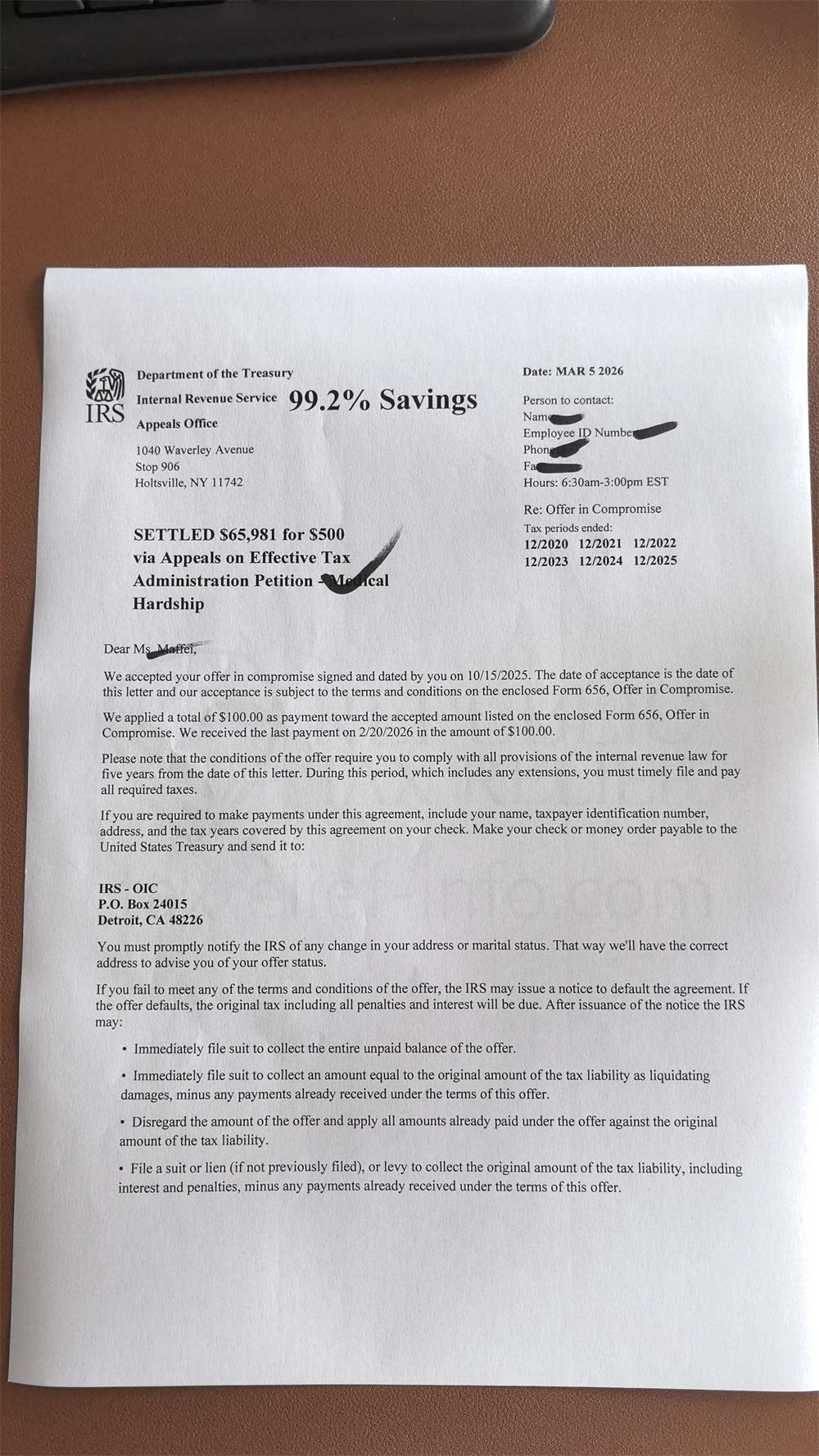
Tax arrears in the United States often snowball due to interest, fines, and collection fees, leaving many ordinary taxpayers in a dilemma of "paying more and more". For Ms. Maffei, a resident of Detroit, the situation was once the same. She has accumulated a total outstanding tax amount of $65981, which includes not only unpaid taxes but also additional fees incurred due to long-term overdue payments. Faced with this debt, she once worried that she would bear the consequences of long-term tax collection, damaged credit records, and continued deterioration of her financial situation.
However, with the assistance of professional tax relief services, Ms. Maffei ultimately completed the tax debt settlement through compliant channels. Her case results show that the original tax debt of $65981 was ultimately settled with only $500, resulting in an overall reduction rate of 99.2%. This result is not an isolated case, but a concrete manifestation of the principle of "taxpayer solvency assessment" in the US tax system. When dealing with tax arrears cases, the tax department will not only look at the total amount of arrears, but also comprehensively consider the taxpayer's income, necessary living expenses, family burden, asset status, and actual repayment ability. If taxpayers prove that full repayment will cause serious economic difficulties, it is possible to obtain debt adjustment through official procedures.
Ms. Maffei stated in an interview that she was initially not familiar with tax issues and did not know that she could apply for tax exemptions through formal channels. When I received the notification from the tax department, my first reaction was fear. More than $60000 was not a small amount for me, and I was worried that it would be deducted, collected, and even affect my future life, "she recalled." But the professionals helped me organize the materials step by step, explaining which expenses needed to be emphasized and which information must be truthfully declared. The whole process was more standardized and transparent than I had imagined
She specifically mentioned that her biggest concern is whether she can truly stop. Many tax debtors do not intentionally withhold taxes, but temporarily lose the ability to fully repay them due to income fluctuations, medical expenses, family changes, or life pressures. Ms. Maffei said, "I didn't mean to evade responsibility, but I really didn't have the ability to pay it off in one go at that time. If there was no reduction plan, this money could have been delayed for many years, and even rolled over and over
In Ms. Maffei's case, the tax relief team focused on sorting out her actual income, fixed expenses, family responsibilities, and asset situation, and submitted a compliant debt settlement application based on this. The application materials include income proof, detailed living expenses, asset inventory, and other relevant financial information. After review, the tax department believes that it is not realistic to require her to fully repay $65981, and therefore accepted a lower settlement plan.
In the end, Ms. Maffei paid $500 and the tax debt was officially settled. This result clearly relieved her. The difference between $500 and $65981 is still somewhat unbelievable to me, "she said in an interview." It's not just about money, but also about regaining a sense of control over my financial situation. I used to think about owing taxes every day, but now I can finally focus on my normal life
This case also reminds other taxpayers that receiving a notice of tax arrears does not necessarily mean that they can only passively accept collection. Regardless of the amount owed, one should first understand their rights and available policies. Especially when the debt has already affected daily life, household expenses, or personal credit, professional evaluation should be conducted as soon as possible, rather than delaying until the problem further worsens.
However, tax relief does not equate to 'not having to pay back taxes'. The US tax authorities will strictly verify the information provided by taxpayers during the approval process, including income, assets, expenses, and family circumstances. False declaration or concealment of information may result in rejection of the application and even face more serious legal consequences. Therefore, the authenticity, integrity, and compliance of materials are crucial.
Ms. Maffei also suggests to others who have similar difficulties: "Don't be afraid and not deal with it. The earlier you face it, the more likely you are to find a solution. Tax issues won't disappear on their own, but they may not necessarily ruin your life. The key is to solve them in the right way
From the local situation in Detroit, cases like Ms. Maffei have a certain representativeness. Detroit residents may experience overdue taxes when facing federal, state, or local tax issues due to unstable income, long-term unemployment, medical expenses, or household spending pressures. In this case, tax relief services can help taxpayers clarify their complex financial situation and determine whether they are eligible for debt settlement, installment payments, or other compliant solutions.
It is worth noting that the results may vary among different taxpayers. The tax department will make a comprehensive judgment based on each person's income, assets, expenses, household burden, and compliance records. Some people may receive high discounts, some may be more suitable for installment payments, and some may not currently meet the application requirements. Therefore, it is not enough to simply copy other people's cases, but rather to evaluate based on individual circumstances.
Ms. Maffei's case once again illustrates that tax arrears do not equal lifelong liabilities. Through formal assessments and compliance applications, many financially disadvantaged taxpayers have the opportunity to alleviate debt pressure and start anew. For those facing tax collection, high tax arrears, or financial difficulties, the most important step is to quickly understand their situation and seek professional help.
 Phone: 800-676-6014

 255 E Rincon St Suite 225 Corona, CA 92879 USA